
Aplicación de metodologías de Machine Learning para mejorar las decisiones de compraventa de activos basados en criptomonedas
DOI:
https://doi.org/10.30973/progmat/2025.17.3/4Palabras clave:
Trading de criptomonedas, activos digitales, análisis de sentimientos, redes neuronales recurrentes, predicción de precios, backtestingResumen
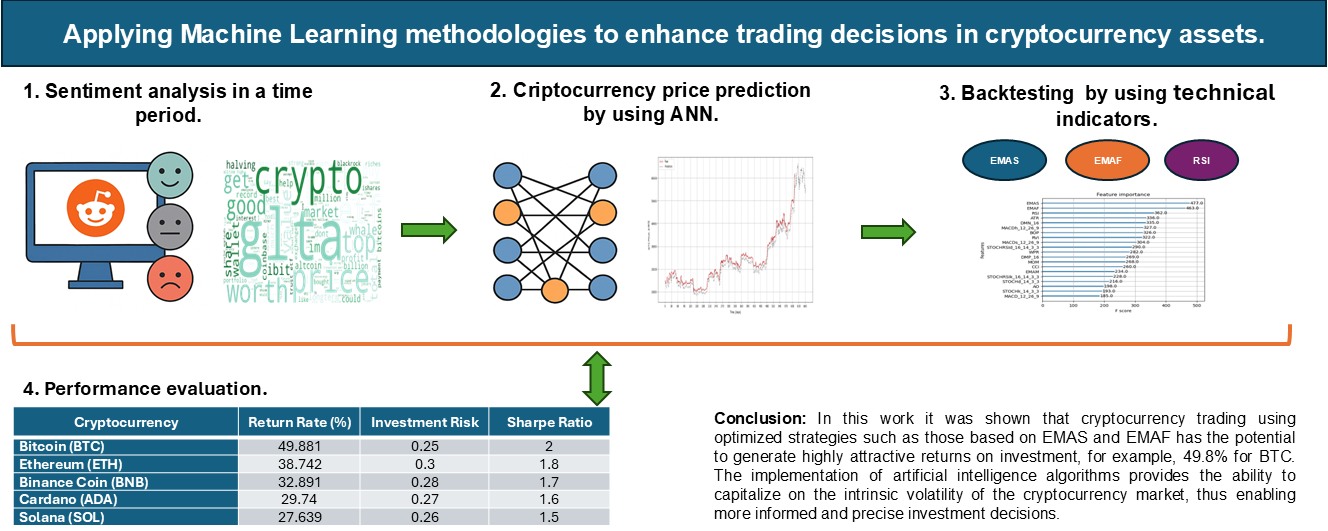
El trading de criptomonedas implica la compra y venta de activos digitales, como Bitcoin (BTC) y Ethereum, con el fin de obtener beneficios financieros a través de plataformas especializadas conocidas como exchanges. La relevancia de esta práctica reside en su capacidad para capitalizar la notable volatilidad del mercado, permitiendo la obtención de rendimientos significativos. Este estudio se centra en la aplicación de algoritmos de aprendizaje automático para la toma de decisiones estratégicas en el ámbito de las criptomonedas, con un enfoque particular en el análisis de sentimientos extraídos de publicaciones en Reddit.com para evaluar la percepción del mercado. La inherente volatilidad del mercado de criptomonedas, junto con influencias psicológicas y asimetrías de información, subraya la importancia del análisis de sentimientos para prever movimientos de precios y optimizar estrategias de trading. Este análisis clasifica el sentimiento en categorías positivas, negativas o neutras, orientando así las decisiones de trading. Además, se emplea una red neuronal recurrente para predecir los precios de BTC utilizando datos históricos, complementando el análisis de sentimientos. La evaluación de indicadores técnicos permite identificar el momento óptimo para operar en el mercado, y el backtesting revela rendimientos notables, especialmente en BTC con 49.88%, Ethereum (38.74%), Binance Coin (32.89%), Cardano (29.74%) y Solana (27.64%). El estudio demuestra que los modelos de aprendizaje automático ofrecen predicciones precisas y reducen los sesgos en comparación con las plataformas de trading tradicionales. No obstante, se destaca la necesidad de adaptación y diversificación continua debido a la volatilidad del mercado y a las incertidumbres regulatorias. Se sugiere que futuras investigaciones se enfoquen en probar estrategias.
Citas
Weerawarna R, Miah SJ, Shao X. Emerging advances of blockchain technology in finance: a content analysis. Personal and Ubiquitous Computing. 2023;27(4):1495-1508. doi: https://doi.org/10.1007/s00779-023-01712-5.
European Central Bank. Virtual Currency Schemes. Frankfurt, Germany: European Central Bank; 2012. Available from: https://www.ecb.europa.eu/pub/pdf/other/virtualcurrencyschemes201210en.pdf.
Ribes EA. Transforming personal finance thanks to artificial intelligence: myth or reality? Financial Economics Letters. 2023;2(1). doi: https://doi.org/10.58567/fel02010002.
Companies Market Cap. Largest Companies by Market Cap [Internet]. 2024 [cited 2025 Sep 21]. Available from: https://companiesmarketcap.com/.
Hosen M, Thaker HMT, Subramaniam V, Eaw HC, Cham TH. Artificial Intelligence (AI), Blockchain, and Cryptocurrency in Finance: Current Scenario and Future Direction. In: Proceedings of the 2nd International Conference on Emerging Technologies and Intelligent Systems; 2023. p. 322-332. doi: https://doi.org/10.1007/978-3-031-25274-7_26.
Makarov I, Schoar A. Cryptocurrencies and Decentralized Finance (DeFi). Brookings Papers on Economic Activity. 2022;(1):141-215. doi: https://dx.doi.org/10.1353/eca.2022.0014.
Koehler S, Dhameliya N, Patel B, Anumandla S. AI-Enhanced Cryptocurrency Trading Algorithm for Optimal Investment Strategies. Asian Accounting and Auditing Advancement. 2018;9(1):101–114. Available from: https://www.researchgate.net/profile/Samuel-Koehler/publication/380710990_AI-Enhanced_Cryptocurrency_Trading_Algorithm_for_Optimal_Investment_Strategies/links/664a40ed0b0d28457447f2c4/AI-Enhanced-Cryptocurrency-Trading-Algorithm-for-Optimal-Investment-Strategies.pdf.
Amirzadeh R, Nazari A, Thiruvady D. Applying Artificial Intelligence in Cryptocurrency Markets: A Survey. Algorithms. 2022;15(11):428. doi: https://doi.org/10.3390/a15110428.
Tungdajahirun N, Makasiranondh W, Pidchayathanakorn P, Chaisiriprasert P, Kasemsawasdi S. Utilizing Artificial Intelligence in Cryptocurrency Trading: a Literature Review. In: 2023 7th International Conference on Information Technology (InCIT); 2023. p. 147-152. doi: http://dx.doi.org/10.1109/InCIT60207.2023.10413042.
Akila V, Nitin MVS, Prasanth I, Sandeep Reddy M, Akash Kumar G. A Cryptocurrency Price Prediction Model using Deep Learning. E3S Web of Conferences. 2023;391:01112. doi: https://doi.org/10.1051/e3sconf/202339101112.
Sasha V. Predicting Future Cryptocurrency Prices Using Machine Learning Algorithms. Journal of Data Analysis and Information Processing. 2023;11(4):400–419. doi: http://dx.doi.org/10.4236/jdaip.2023.114021.
Feizian F, Amiri B. Cryptocurrency Price Prediction Model Based on Sentiment Analysis and Social Influence. IEEE Access. 2023;11:142177-142195. doi: http://dx.doi.org/10.1109/ACCESS.2023.3342688.
Santín A. Peer 2 Peer. Sistemas Operativos Distribuidos [Internet]. 2017 [cited 2025 Sep 21]. Available from: https://www.dit.upm.es/~joaquin/so/p2p/p2p.pdf.
Nakamoto S. Bitcoin: A Peer-to-Peer Electronic Cash System [Internet]. 2008 [cited 2025 Sep 21]. Available from: https://bitcoin.org/bitcoin.pdf.
Narayanan A, Bonneau J, Felten EW, Miller A, Goldfeder S. Bitcoin and cryptocurrency technologies. Princeton, NJ: Princeton University Press; 2016.
Tapscott D, Tapscott A. The trust protocol: How blockchain technology will change money, business and the world. Penguin; 2016.
Zheng Z, Xie S, Dai HN, Chen X, Wang H. Blockchain challenges and opportunities: a survey. International Journal of Web and Grid Services. 2018;14(4):352. doi: https://doi.org/10.1504/IJWGS.2018.095647.
Swan M. Blockchain: Blueprint for a new economy. Sebastopol, CA: O’Reilly Media; 2015.
Černevičienė J, Kabašinskas A. Review of Multi-Criteria Decision-Making Methods in Finance Using Explainable Artificial Intelligence. Frontiers in Artificial Intelligence. 2022;5. doi: https://doi.org/10.3389/frai.2022.827584.
Sánchez J. Criptomonedas [Internet]. Corte Suprema de Justicia de Paraguay; 2018 [cited 2025 Sep 21]. Available from: https://www.pj.gov.py/ebook/monografias/extranjero/civil/Julia-Sanchez-Criptomonedas.pdf.
Hutto C, Gilbert E. VADER: A Parsimonious Rule-Based Model for Sentiment Analysis of Social Media Text. Proceedings of the International AAAI Conference on Web and Social Media. 2014;8(1):216–225. doi: https://doi.org/10.1609/icwsm.v8i1.14550.
Semrush. March 2024 Traffic Stats [Internet]. 2024 [cited 2025 Sep 21]. Available from: https://es.semrush.com/website/reddit.com/overview/.
Murphy JJ. Technical analysis of the financial markets: A comprehensive guide to trading methods and applications. New York: New York Institute of Finance; 1999.
Descargas
Publicado
Cómo citar
Número
Sección
Licencia
Derechos de autor 2025 Víctor Leonardo Teja Juárez, Luis Cedeño Parra, Julio Isaac Manzano Reséndiz

Esta obra está bajo una licencia internacional Creative Commons Atribución 4.0.
Usted es libre de:
 |
Compartir — compartir y redistribuir el material publicado en cualquier medio o formato. |
 |
Adaptar — combinar, transformar y construir sobre el material para cualquier propósito, incluso comercialmente. |
Bajo las siguientes condiciones:
 |
Atribución — Debe otorgar el crédito correspondiente, proporcionar un enlace a la licencia e indicar si se realizaron cambios. Puede hacerlo de cualquier manera razonable, pero de ninguna manera que sugiera que el licenciador lo respalda a usted o a su uso. |
| Sin restricciones adicionales: no puede aplicar términos legales o medidas tecnológicas que restrinjan legalmente a otros a hacer cualquier cosa que permita la licencia. |